


Last week we posted our first piece outlining how agentic AI will transform primary care.
We discussed how primary care still runs on the 8am phone lottery and three-week waits. With our ageing populations and a shrinking GP supply, a system already past capacity cannot be easily patched. The medicine is fine, but the distribution model belongs to another century. The prize for rebuilding it is a share of the $10 trillion (a tenth of everything humanity produces) that health consumes each year.
In part 2, we double click on each of the five areas where we see the biggest opportunities for change.
We don’t think this is rocket science. In fact, conceptualising how the system should work is the easy part. Building and distributing these companies across a continent of different market structures however, will be the key challenge.
The blocks of change
In our view there are five key areas where AI will transform primary care. They span the first moment you need to check your symptoms, through to a physical examination and ongoing monitoring.
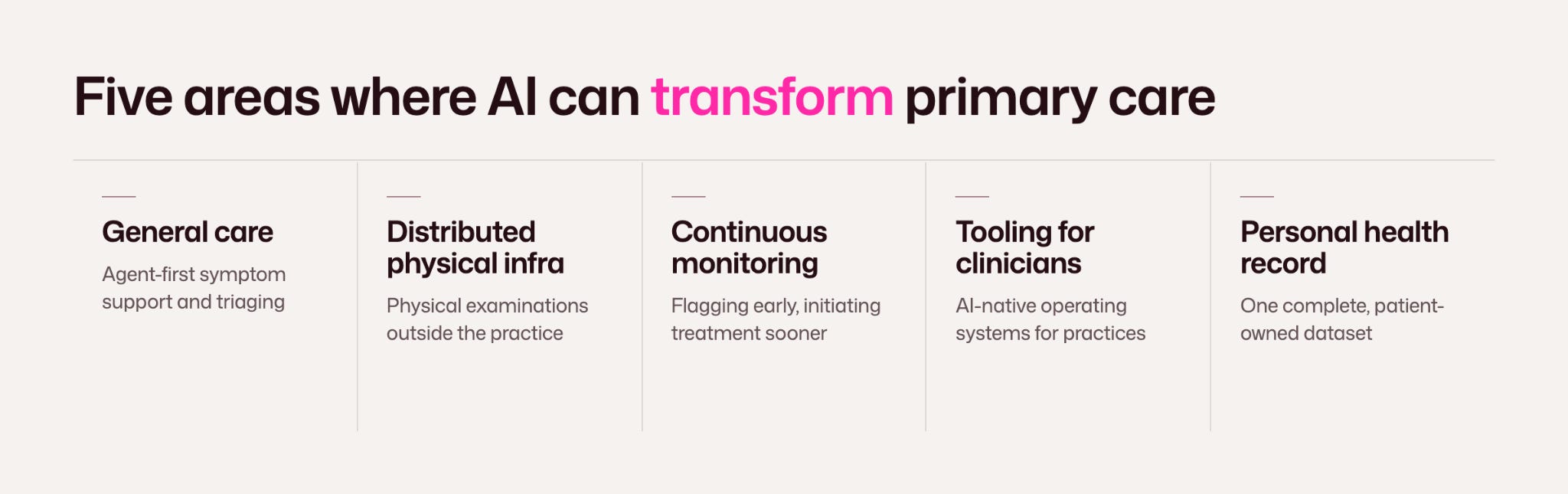
We believe in the age of AI agents, there is a unique opportunity to create a system that offers high-quality and in-time care, whilst slashing the vast and growing cost burdens on our healthcare system.
What could this new system look and feel like?
1. General Care & Triage
Instead of the phone lottery at 8am, your first medical conversation will be with a certified agent that knows your medical history, asks what a good GP would ask, and resolves most concerns on the spot; only the minority of cases that genuinely need a clinician get routed onward.
This already exists. Roughly 230 million people ask ChatGPT questions about their health every week, and in January OpenAI shipped ChatGPT Health with medical-record sync built in.
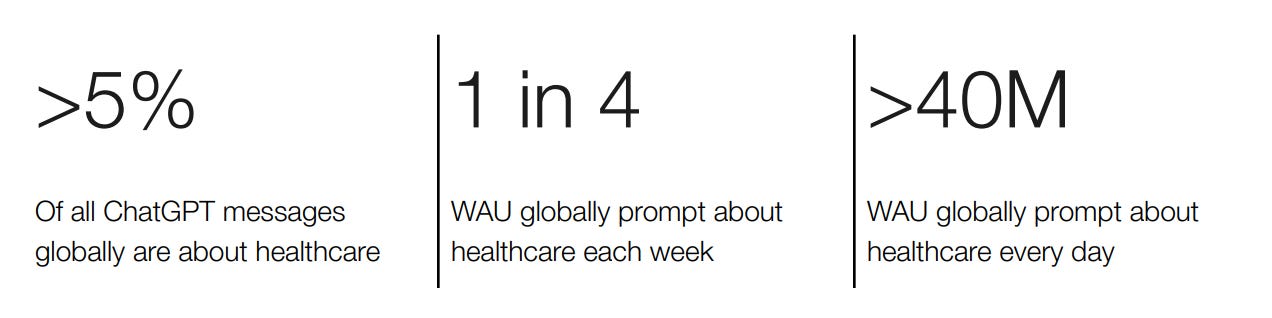
OpenAI: AI as a Healthcare Ally
However, there is a demand for an AI that is properly supervised by GPs. In the USA there are already the first well funded tech companies such as Counsel Health ($36M from a16z and GV) that resolves most member concerns in minutes with physicians supervising 15 to 20 visits an hour, while Doctronic ($65M) persuaded Utah to let its AI renew prescriptions autonomously, a regulatory first. One supervising physician per twenty visits changes what a health system costs.
When a clinician is needed, the consultation happens on video, prepared in advance by an agent so the doctor’s time goes on judgement instead of history-taking. This is clearly not a technology bottleneck. The company to crack it, will need to find a way to maneuver the complex incentive scheme of the medical systems. For agents to take the first call with patients, there needs to be a business model, paying a machine for a consultation. Doctors will not only be able to bill for online consultations but also for supervising agentic consultations.
In theory insurance companies are very well placed to offer this - they have a reason to drive efficiency. However, it takes real courage to bend the system to introduce such a radical new form of care delivery. We do not think the current incentive scheme of insurance companies is set up to do so.
Larger private healthcare organisations such as eyecare clinic chains or or other health chains, could do this to better triage their large backlogs of patients. Even if they are not explicitly re-imbursed, they will improve the efficiency of their operations and help medical staff focus on the cases that matter the most.
In the long term governments will reimburse these agentic consultations. The only questions is how long will this take? In the meantime there are many companies in Europe who have started with agentic administrative triangulation, for example Vocca or Praxipal in the scheduling space. The business case for these applications exists from day 1, but we believe that in the long term these types of applications will commoditize. The key risk is that the practice management system or hospital information system will end up offering this as a feature and replace them.
There is a real opportunity to build THE trusted agentic partner for healthcare providers, if you are able to maneuver the complex regulatory/market structures of Europe. Which founding team is obsessed enough with this mission? Get in touch!
2. Distributed Physical Infrastructure
Instead of an hour in a waiting room, the physical parts of care (bloods, imaging, swabs, the knee examination) will happen near you - at the pharmacy downstairs or your own kitchen table, done by a nurse or trained assistant. Holding a needle does not require a decade of medical school.
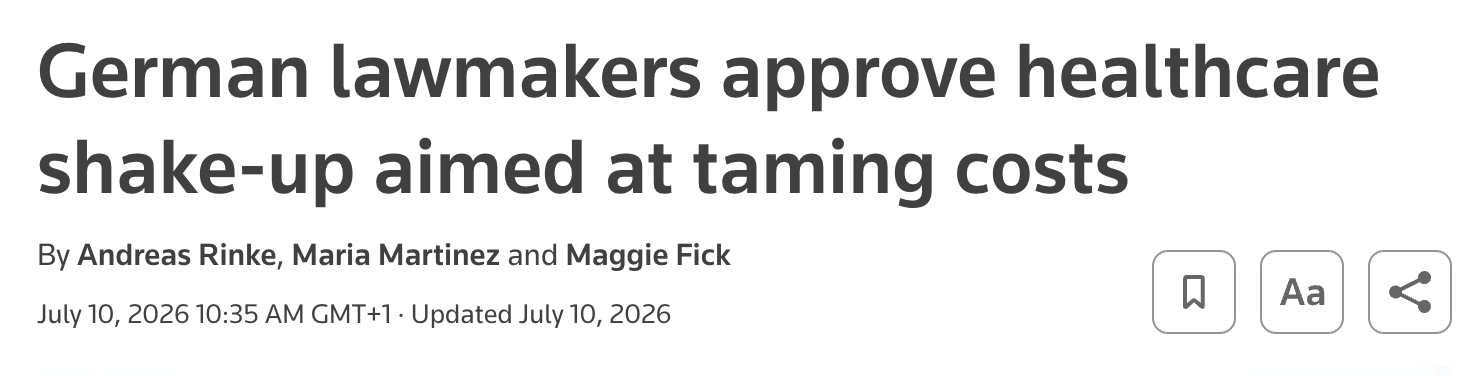
European regulation recently moved decisively in favour of this transition. Germany’s pharmacy reform, passed earlier this year, lets pharmacists draw blood, vaccinate, run rapid tests, deliver assisted telemedicine and dispense chronic medication without a fresh prescription, turning 17,500 pharmacies into care endpoints overnight. In the UK, pharmacists are generally already set up to offer routine examinations that were traditionally conducted in a GP surgery.
At the same time, these new points of care need to be equipped with skilled labor, medical equipment and infra to actually serve patients. This will take some time to be adopted, but we expect that this will be a boon for relieving pressure from the overflowing waiting rooms where people come in to get blood drawn by highly skilled nurses.
This transition will not happen without pain. A group of people filed lawsuits against a drugstore chain in Germany for offering eye examinations in their retail store. The winning team in this space will need to maneuver well through the existing systems and unlock a real behavioural shift… easier said than done!
Building in this space will require teams working on both a new brand of services company, as well as technology infrastructure. This infra would then allow this node of the system to be integrated into the wider healthcare system - think, personal health records, hospital interventions, wearables, and so on.
These new services companies will be very attractive businesses, but not typical VC cases. Revenues will scale with locations. We expect these will be interesting cases for PE.
The opportunity to scale exponentially is around the technology infra needed to unlock distributed physical care. The software that enables teams to scale the number of partners and patients, without scaling people or locations.
An example is our portfolio company Mirantus who are building the software layer that connects patients with the doctors and opticians who do the examination on the ground. The Mirantus platform gives patients a “virtual clinic” experience where all healthcare professionals work closely together without being bound to one physical location. The result is an outstanding patient experience, whether in the heart of the city or in a medical desert where no eye doctors are available. The physical examination is done by an optician and the rest over the virtual platform.
Another interesting model in this new care infrastructure is of course Neko Health ($325M raised, valued at $1.8B). They combine examination “through machines” with access to high-end specialist care, but without entering a traditional doctor practice. We think Neko has been able to demand such a high valuation because of the huge potential of combining care delivery with the data they gather.
In essence, the physical infrastructure for healthcare services will change in the coming years. Some models will be service heavy and remain out of sight for VC. Other models we expect to build critical software infra that unlocks a whole new category of ‘virtual clinics’.
3. Continuous Monitoring
When you exit a clinic, your levels remain monitored. Some continuously, others via simple, periodic at-home procedures. You are notified to attend your local practitioner, or visited at-home, if any additional intervention is needed. You are invited back to hospital only if critical.
Care shouldn’t end at discharge, but in 2026 the system behaves as if it does. Across European health systems, between one in ten and one in five patients sent home from hospital are back within 30 days, and roughly a quarter of those returns are judged preventable (source).
In a recent study in the UK, four of the five reasons for a delayed discharge were capacity and process - around 10.5k weekly patients are delayed for these reasons. Only a tiny proportion were for health-relevant concerns. In essence, people are eating up hospital capacity for avoidable reasons!
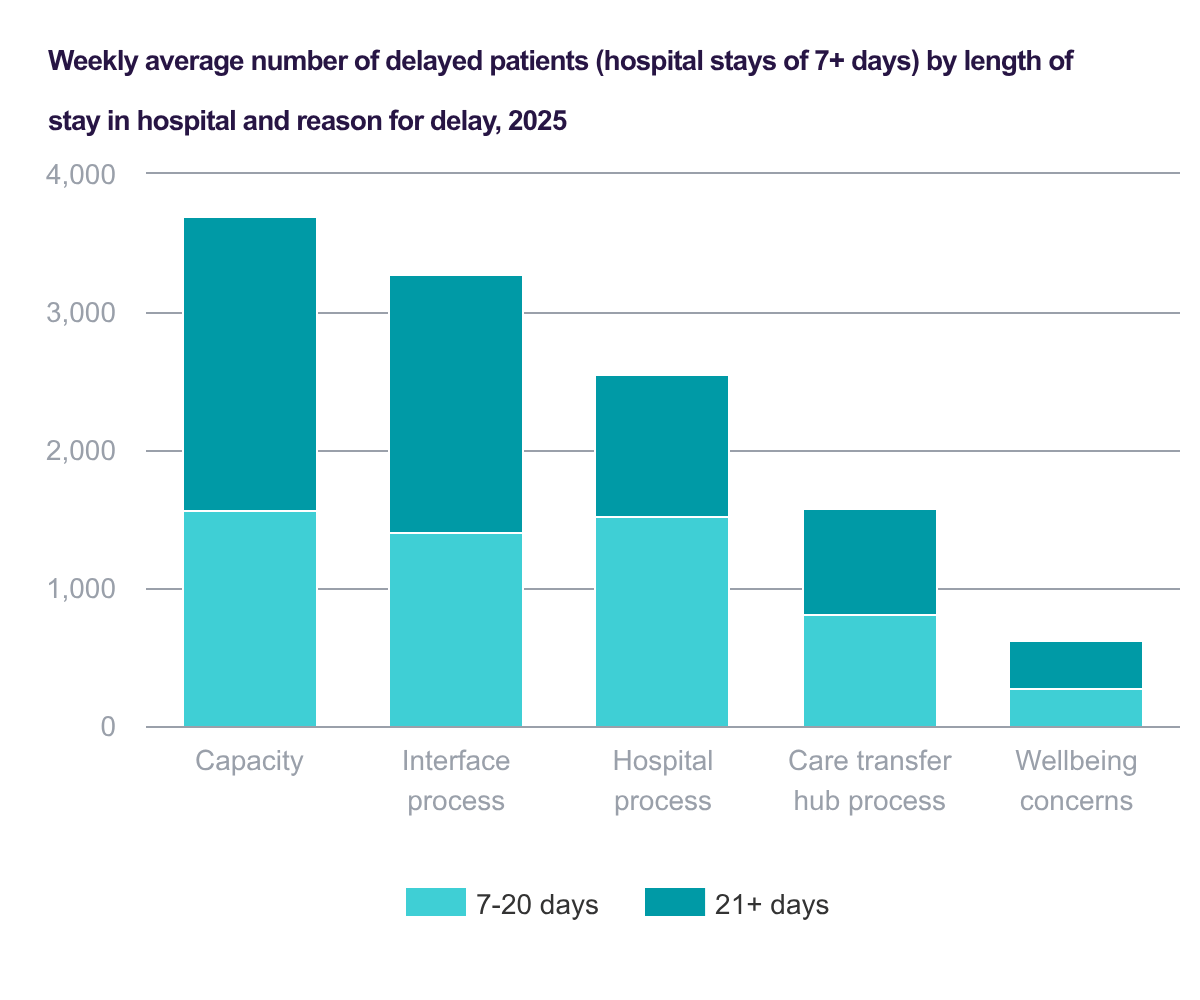
The opportunity that monitoring allows for the system to focus only on those with the acute need is very clear. Our view is that if you have confidence that non-critical patients will be monitored remotely, you are able to free up beds much quicker.
Our take is that the health systems already know they want this, but they cannot operationally deliver it. What we are seeing with virtual wards is showing how resources are much better managed when we assign resourcing that is commensurate to the need. For example, Doccla runs virtual wards across half of NHS regions with a documented 63% cut in A&E attendance, and is expanding into France and DACH. Heim Health (just accepted onto the NHS Innovation Accelerator) is building the logistics operating system for in-home care, where operators put around 20% of community nursing time on pure coordination. In the US, Hippocratic AI has raised $402M at a $3.5B valuation selling monitoring and outreach agents to health systems.
In addition to that allow wearables like Apple Watch, Oura and Whoop as well as many connected medical devices for base-level passive monitoring. The continuous measurement of important indicators such as heart rate, blood pressure or body temperature allow agents to monitor millions of patients in parallel and elevate cases that need special attention.
Clearly this requires some systems change as well. The patient data will need to connect with healthcare systems and where needs are acute, inform professionals about critical changes. In a world where hospitals and clinics are still run on decade-old monolith software, the magic of new wearable technology and connected devices cannot be channeled yet.
The winning company in the space will crack rapid, broad distribution. Selling software to doctors in Europe is probably one of the most ungrateful and painful jobs out there. Doctors do not like to change their habits and selling the vision of a ‘new software platform’ is often met with an enthusiastic eye roll. Perhaps this is the era of the headless practice management system, that will be fully voice-only.
4. Tooling for Clinicians
There will be a new technology stack for clinicians. In this world, the clinics will focus on the important cases where significant intervention is needed and clinicians will focus on the skilled work of delivering this (not the million other admin tasks they currently do).
Fortunately, we are seeing the models improve significantly on typical clinician tasks. Whilst there is still a long-way to go, the early signs are very promising. Benchmark data from the GPT-5.4 era put the models a little ahead of human clinicians on typical clinician tasks (44% for the human clinician vs 48% & 59% from the models). More recent data from newer model generations shows that this has continued to improve.
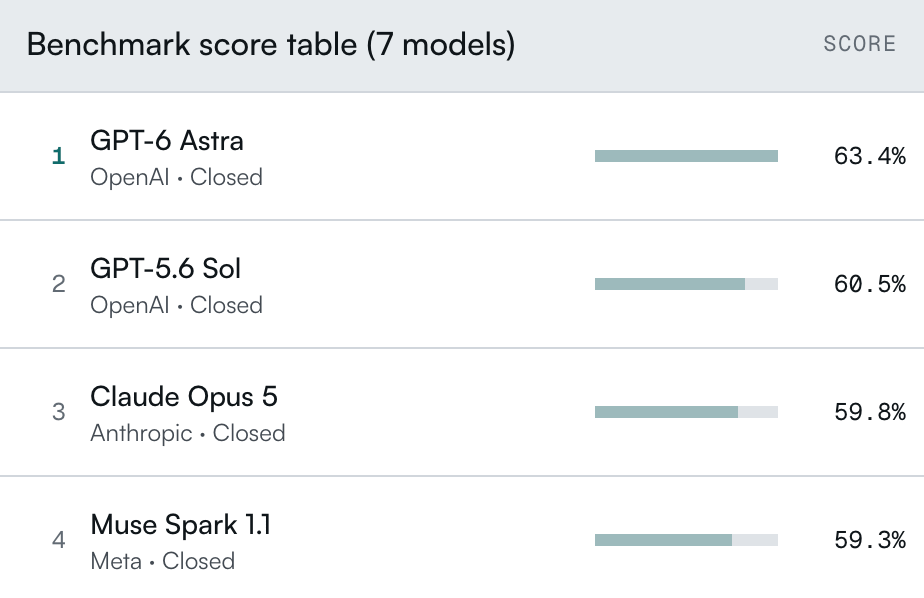
Healthbench Professional. % is the share of physician-rubric points earned
We see the stack, that allows clinicians to focus, being built in three key areas:
Software that makes internal operations more efficient.
This is everything from ambient AI scribes who are listening into patient conversations and documenting it, to new EHR platforms that surface the critical information to the doctors when they need it. Eventually we see a lot of this being delivered as a voice-first platform, letting the doctor focus only on patient interactions.
Software that connects everyone
The new software stack will also be fully integrated into each stakeholder - patients, doctors, pharmacists, at-home care, family members, payors, and so on. This will allow doctors for all specialties, based in different places, to engage with one client record. This can be integrated directly into payor frameworks, generating invoices, checking accounts and where agents can resolve any disputes on claims.
Software that accelerates research
Medical research takes on average over 7 years to hit mainstream treatment practices. This means we are being treated today on the research status of 2019. So many new discoveries have been made in the interim, but that are not yet available to patients. Technology can really help to change this. In the US, already 40% of US physicians are using open evidence showing significant demand for the latest research insights. Your local doctor should be able to diagnose based on the latest knowledge; your nurse should be able to address a wound in the most effective (potentially) novel way. This is about leveling up the quality of care, in every location!
5. Personal Health Record
None of the other four blocks works properly without something healthcare has famously never fully built: a complete, portable record of you. And it doesn’t exist for a structural reason. The patient has never really been the customer. You receive the treatment, someone else pays for it, and the information trail is scattered across a dozen providers with no good reason to reconcile it.
We believe society’s willingness to accept that has expired! People watch their banking and tax data move between apps and will demand the same where the stakes are highest - their health! And it’s easy to imagine a doctor who can see all of you simply treats you better.
AI agents have a big role to play in unlocking a transition to this system. Agents are launched to fetch every record you are legally entitled to, gathering it into a personal vault. This unlocks the ability for agents to operate across your record, monitoring your live data, flagging the anomaly and booking the appointment. This is critical to unlocking the benefits of all the other pillars.
Perhaps the gathering of this data needs to be free, given European patients are not used to actually paying for healthcare services. However, once the value has been demonstrated we believe that there are ways to monetize this, for example through offering a health concierge. Whoever assembles this dataset first holds a key to every other block, and in the long run potentially also to new health discoveries.
Today, platform players like Apple or ChatGPT Health have probably the biggest distribution potential. However, we believe there is room for a European player with a sovereign platform and closer integrations into European healthcare software systems. As we continue to mention, the key challenge for this will be efficient distribution!
To Conclude
In each one of the five blocks, an American company has raised a multiple of its European equivalent. Part of that is simply market size - American healthcare is far more expensive per capita, so the same product captures more dollars. However this is also because the American system is adopting technology at a much quicker rate.
European healthcare markets are notoriously hard to access and operate in an extremely fragmented way - each with its own payer logic and regulation. It is rare to be operating in more than three European countries.
However, we believe this is actually a hyper attractive market - this is about intelligent distribution. The technology solution is pretty clear and often has been implemented in the US or Asia already. To build a European decacorn in healthcare, entrepreneurs must ‘simply’ crack the incentive scheme and in turn achieve distribution. The ones that do, have a recession proof, gigantic and growing market, where incumbents are offering incredibly outdated technology.
📣 Calling all incredibly ambitious founders… Go and get it! Bring the European healthcare ecosystem into an agentic age! We would love to support you on this journey.
We have the third and final part of this series coming out next week, where we’ll be sharing a market map of this space. Stay tuned!